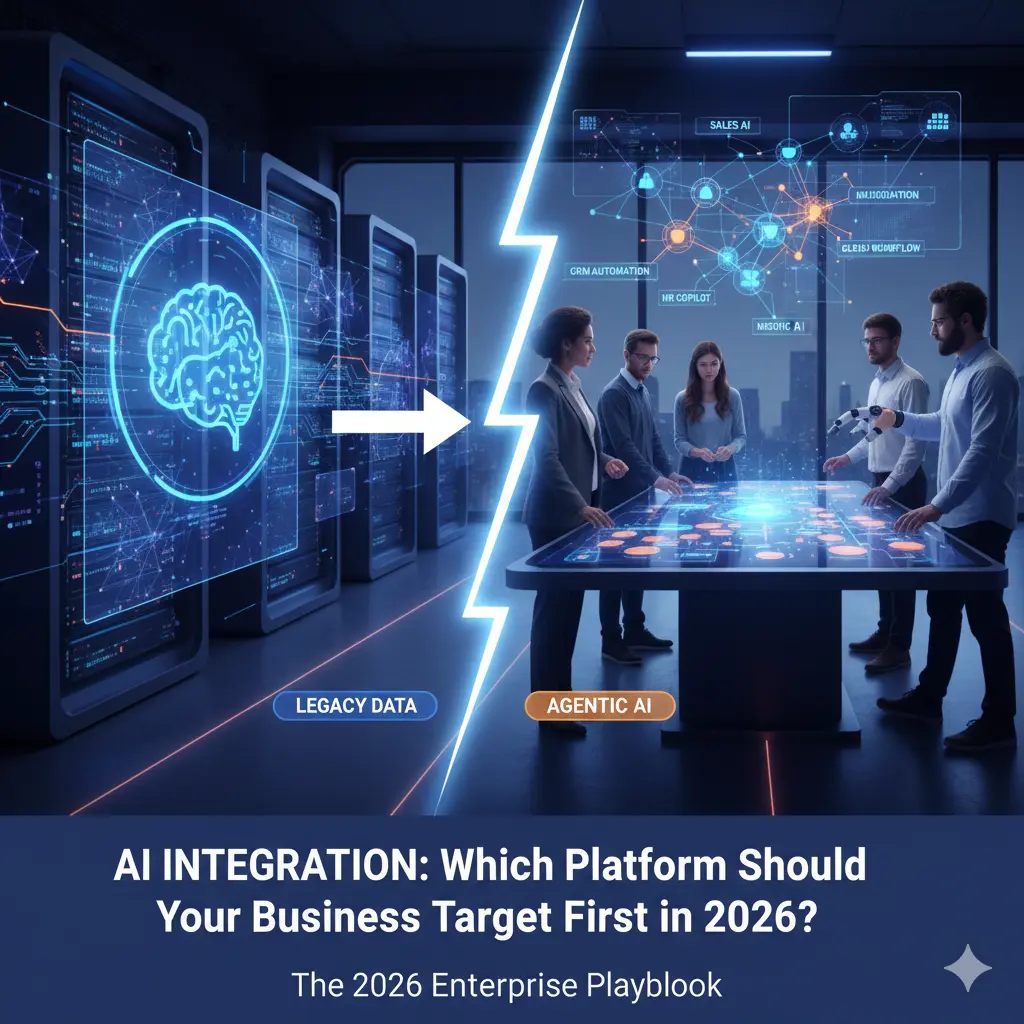
In 2026, the question is no longer "Should we integrate AI?" but "Where do we land first?" The honeymoon phase of experimental chatbots is over. We have entered the era of Agentic AI—autonomous systems that don’t just suggest text, but execute multi-step workflows across your entire business stack.
For a business leader, the landscape is crowded. Between the "Big Three" cloud giants and a new wave of specialized vertical platforms, choosing your first point of integration will define your technical debt and competitive speed for the next five years.
To decide where to target first, you must identify your business’s current "pain gravity." Most organizations fall into one of three categories:
If your business already lives in Microsoft 365 or Google Workspace, your path of least resistance is the integrated cloud platform. In 2026, these are no longer just "hosting" services; they are "intelligence layers."
Microsoft Azure AI: With the deepest integration into the Office suite via Copilot, Azure is the target for businesses focused on internal productivity. If your goal is to automate legal document reviews, HR onboarding, or financial reporting within Excel and Teams, Azure is your first stop.
Google Vertex AI: By early 2026, Google has pulled ahead in multimodal search and cost-efficiency. If your business relies on massive data retrieval (like a global logistics firm or a research-heavy medical practice), Vertex AI’s ability to "ground" models in your private data is unparalleled.
Direct integration with model providers like OpenAI (GPT-5.1/6) or Anthropic (Claude 4) is for businesses that need cutting-edge reasoning and brand-specific creativity.
OpenAI: Still the leader in "raw" intelligence and multi-modal generation (Sora for video, DALL-E 4 for design). Target this if you are a marketing-first company or a startup building a custom AI-native product.
Anthropic: In 2026, Claude has become the "Corporate Conscious" choice. Its focus on "Constitutional AI" makes it the safest first target for customer-facing support or any industry where brand voice and ethical guardrails are non-negotiable.
Sometimes, the best platform isn't a "brain," but a "worker." 2026 has seen the rise of vertical-specific AI:
Shopify Sidekick: For e-commerce businesses, this is the first target. It manages inventory, writes descriptions, and handles returns autonomously.
HubSpot AI CRM: For sales-driven organizations, targeting the CRM first ensures your AI actually knows your customers' history before it tries to sell to them.
Platform | Primary Strength | Best Target For | 2026 Integration Trend |
Azure AI | Enterprise Security | Corporate Operations | "Agentic" workflows in Teams/Office |
Google Vertex | Data Grounding/Search | Data-Heavy SMBs | Hyper-fast "RAG" (Retrieval) |
OpenAI | Creative Reasoning | Marketing & Devs | Multimodal (Voice/Video) bots |
Anthropic | Ethical Accuracy | Customer Support | Safe, long-context document analysis |
Export to Sheets
The biggest mistake a business can make in 2026 is integrating AI as a simple "Q&A" tool. The market has moved to Agentic Workflows. Unlike traditional AI, which waits for a prompt, an AI Agent monitors your data and acts.
Example: In 2024, an AI might have helped you write an email about a late shipment. In 2026, an integrated AI Agent on your logistics platform detects the delay, checks the warehouse for a replacement, emails the customer a discount code, and updates your CRM—all before you even open your laptop.
To pick your platform, run this 3-step audit:
Data Sovereignty: Does your industry (Legal, Healthcare) require data to stay within a private cloud? If yes, target Azure or AWS Bedrock.
User Interface: Do your employees want to use a new app, or do they want AI inside their existing tools? If the latter, target your SaaS provider’s native AI (e.g., Salesforce or Notion).
Cost vs. Capability: Are you doing high-volume, simple tasks (Google) or low-volume, high-intelligence tasks (OpenAI/Anthropic)?
The risk in 2026 isn't just about losing money; it’s about Data Silos. If you integrate a different AI tool for every department without a central strategy, you create "hallucination gaps" where your marketing AI doesn't know what your sales AI promised.
To avoid this, many businesses are adopting a Hybrid Strategy: using a heavy-hitter like Azure for data infrastructure while plugging in specialized "Agentic" tools for specific tasks like social media or customer support.
In 2026, the winner isn't the company that uses the most AI; it’s the company that integrates it most deeply into its core processes. If you are paralyzed by choice, the safest and most effective first target is usually the platform that already holds your customer data. Moving your data to the AI is expensive and risky. Bringing the AI to your data—via the platforms you already use—is the fastest way to see an ROI by the end of this quarter.
Would you like me to draft a 30-day implementation roadmap for one of these specific platforms based on your current tech stack?