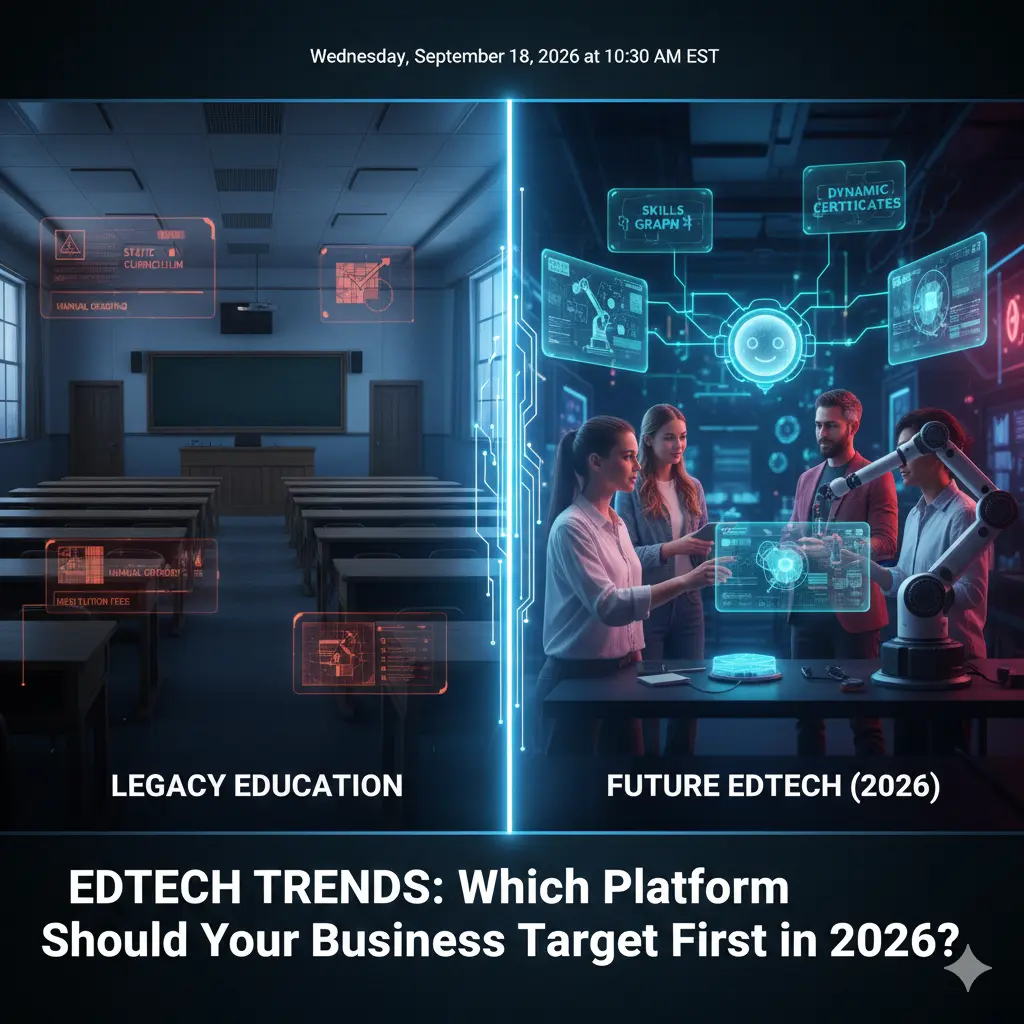
The year 2026 has officially moved past the "experimental" phase of AI in education. We are no longer debating whether AI should be in the classroom or the boardroom; we are witnessing its structural integration. For businesses looking to invest in, partner with, or adopt educational technology, the landscape has shifted from content-heavy libraries to Outcome-Engineered Ecosystems.
In 2026, the "Standard Course" is dead. It has been replaced by adaptive, skills-based credentials that are recognized by employers as a "verified currency" for hiring. But with a sea of platforms—from the legacy giants to the new AI-native startups—where should your business focus its resources first?
To determine your target platform, you must understand the three categories of "learning infrastructure" that define this year's market:
These platforms focus on Credential Portability. They provide the "official" certificates that bridge the gap between education and employment.
These are AI-Native ecosystems. They don't just provide content; they provide personalized "tutors" and "teaching assistants" that adapt to the learner in real-time.
These platforms focus on Internal Knowledge Loops. They allow companies to turn their own subject matter experts (SMEs) into instructors, creating a bottom-up learning culture.
Best For: Companies needing standardized upskilling, accredited certifications, and degree-level training.
By 2026, Coursera has become the "Gold Standard" for Skills-Based Hiring. Their partnership with over 350 top-tier universities (like Stanford and Yale) and tech giants (like Google and IBM) means their certificates carry the weight of a mini-degree.
Why target it first? If your business needs to verify that a new hire actually knows Python or Data Analytics, Coursera is your best bet. Their 2026 "Skills Graph" allows you to map specific course outcomes directly to your company's open roles.
The 2026 Advantage: Coursera’s "Guided Labs" now feature AI-proctoring and real-time sandbox environments where learners can practice coding or management simulations without leaving the platform.
Best For: Educational institutions, training agencies, and businesses looking to automate content creation.
MagicSchool AI has moved from a K-12 tool to a broad-spectrum Instructional Design engine. It is the leader in reducing "educator burnout" by automating 80% of administrative and content creation tasks.
Why target it first? If your business is in the business of teaching (e.g., a training consultancy), MagicSchool is your force multiplier. It allows one instructor to do the work of five by instantly generating personalized lesson plans, assessments, and feedback loops.
The 2026 Advantage: Their "Personalized Learning Pathways" feature uses AI to identify knowledge gaps in a workforce and automatically generates custom micro-learning modules to fill them overnight.
Best For: SMEs and Enterprises that want to foster "Collaborative Learning" rather than top-down instruction.
In 2026, the most valuable knowledge often lives inside your employees' heads, not in a pre-packaged course. 360Learning focuses on Collaborative Learning, allowing teams to co-create training modules.
Why target it first? If your business has unique internal processes (e.g., a proprietary sales methodology or specialized engineering workflow), you can't buy a course for that on Udemy. 360Learning provides the tools to build it internally.
The 2026 Advantage: Their AI-Course Authoring tool allows an expert to record a 5-minute video and automatically turns it into a structured, interactive course with quizzes and certifications.
Platform | Primary Strength | Best Business Alignment | Key 2026 Tech |
Coursera | Global Credibility | Recruiting & Compliance | AI-Guided Labs & Skills Graph |
360Learning | Internal Collaboration | Peer-to-Peer Training | AI-Assisted Course Authoring |
LinkedIn Learning | Professional Visibility | Individual Career Growth | AI-Powered Career Pathing |
MagicSchool AI | Operational Efficiency | Schools & Training Agencies | Automated Instructional Design |
Export to Sheets
To succeed in 2026, your EdTech strategy must address these three "Non-Negotiables":
Degrees are becoming secondary to Skills-Based Credentials. In 2026, platforms that offer "stackable" credentials (small certificates that build toward a larger qualification) are seeing the highest ROI.
As of April 2024, new regulations began hitting the market. By 2026, any EdTech platform you choose must meet strict accessibility standards. If your platform isn't "Screen Reader Friendly" or doesn't offer "Low-Bandwidth" modes, you risk legal liability and a fragmented workforce.
Sustainable EdTech in 2026 isn't 100% online. The most successful platforms offer Hybrid (Phygital) Integration, where online learning is reinforced by in-person workshops or physical "maker-spaces."
Your target depends on your Core Business Driver:
For Talent Acquisition & External Validation: Target Coursera. It is the most trusted "CV-booster" in the global market.
For Scaling Internal Productivity: Target MagicSchool AI. Use it to turn your HR or L&D department into an AI-powered powerhouse.
For Retaining Culture & Tribal Knowledge: Target 360Learning. Empower your own people to teach each other.
In 2026, education is no longer a "one-off" event; it is a continuous, AI-assisted operation. Choose the platform that doesn't just deliver content, but builds intelligence.
Would you like me to create an "EdTech Implementation Audit" to see which of these platforms integrates best with your current HR or IT systems?